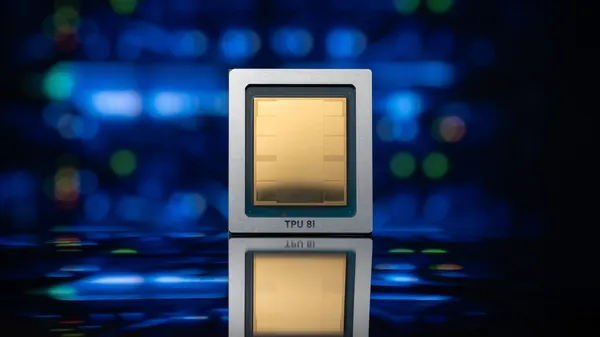

Behind every Google search, every YouTube recommendation, every Gemini response, there’s a chip that does nothing but math. A lot of math, very fast.
Those chips are TPUs—Tensor Processing Units—and they’ve been around for over a decade now. Google designed them from scratch specifically for running AI models, not general-purpose computing. That singular focus is what makes them interesting.
The latest generation pushes things further: 121 exaflops of compute power, with double the bandwidth of the previous generation. That’s a lot of numbers. For context, an exaflop is a quintillion floating-point operations per second. So 121 exaflops means this thing chews through calculations at a scale that’s hard to wrap your head around.
Bandwidth is the real bottleneck in most AI workloads—you can have all the compute in the world, but if you can’t feed data to the chips fast enough, you’re stuck. Doubling it means larger models train faster, and inference feels snappier.
I’ve been watching TPU generations roll out since the first one, and what strikes me is how consistent the trajectory has been. Each iteration focuses on the same pain points: memory bandwidth, interconnect speed, and raw matrix math throughput. No flashy gimmicks, just relentless optimization for the one job they’re built to do.
Google has a video that walks through the hardware in more detail. Worth a look if you’re into chip design or just curious about what powers the AI you use daily.
Comments (0)
Login Log in to comment.
Be the first to comment!