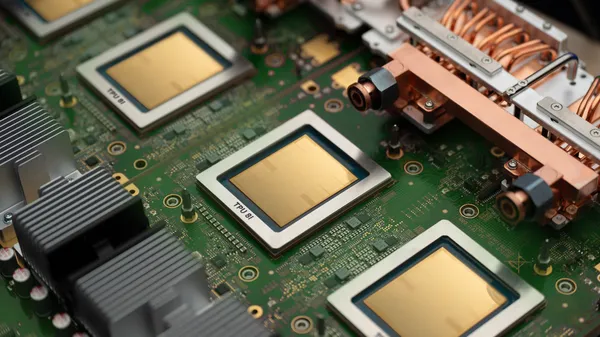

Google just announced its eighth generation of TPUs, and for once, the company isn’t just chasing bigger numbers on a benchmark. They’re splitting the lineup into two specialized chips: one optimized for training, another for inference. That’s a shift worth paying attention to.
For years, TPUs have been Google’s secret sauce for running massive AI workloads—training models like Gemini and powering everything from Search to YouTube recommendations. But the agentic era, as Google calls it, demands something different. Agents don’t just generate text; they reason, plan, and take actions across multiple tools and APIs. That requires a different kind of compute.
The first chip, let’s call it the training beast, is built for the kind of massive-scale model training that Google does internally. It’s designed to handle the enormous memory bandwidth and interconnect demands of training trillion-parameter models. Nothing surprising there—Google has been pushing this direction for a while.
The second chip is the more interesting one. It’s purpose-built for inference, but not just any inference. Google claims it can handle the “long context, multi-step reasoning” that agents require. That’s the part that caught my eye. If you’ve ever run an agentic workflow—like a coding assistant that searches documentation, reads files, and writes code—you know how quickly context windows blow up and how many sequential calls you need. Standard inference hardware chokes on that.
What’s not clear yet is whether these chips will be available to external customers through Google Cloud, or if they’re staying internal. The blog post is vague on that point, which is frustrating. TPUs have historically been Google’s internal workhorses, with limited external availability compared to NVIDIA’s GPUs. If Google wants to compete in the agentic AI infrastructure space, they’ll need to make these accessible.
The timing is interesting. We’re seeing a wave of agentic frameworks—LangGraph, CrewAI, AutoGen—all struggling with the same bottleneck: inference latency on long chains of reasoning. Hardware that can handle this natively could be a game-changer. But I’m skeptical until I see real benchmarks. Google’s TPU performance claims have sometimes been cherry-picked in the past.
Still, the direction is right. Specializing hardware for the workload pattern of agents, rather than treating all AI compute equally, is a smart bet. The question is whether Google can execute on the software side too. TPUs have historically had a steeper learning curve than CUDA. If they can fix that, they might have something.
For now, I’m cautiously optimistic. The agentic era needs better hardware, and Google is one of the few companies with the resources to build it from scratch. Let’s see if they actually ship it.
Comments (0)
Login Log in to comment.
Be the first to comment!